
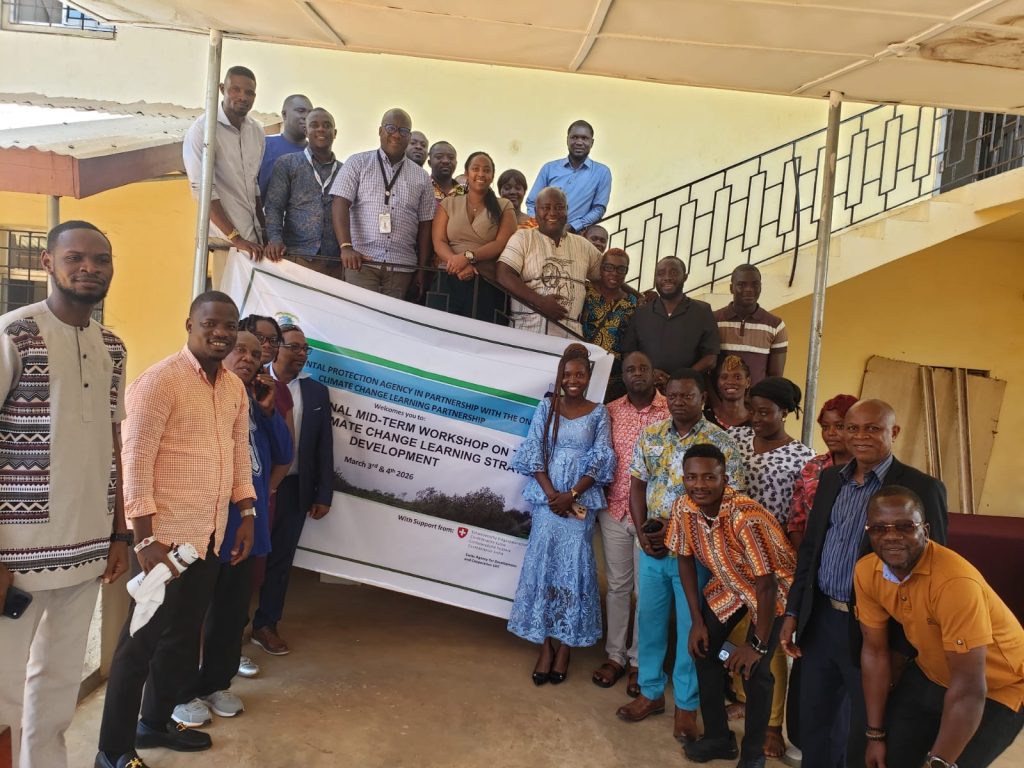
Liberia has taken an important step toward strengthening its national capacity to respond to climate change through education, professional training, and public awareness. On March 3 and 4, stakeholders from government, academia, civil society, and international partners convened at the National Climate Action Laboratory at the University of Liberia for the Mid-Term Workshop to validate the Assessment Report and Outline for the Development of Liberia’s Climate Change Learning Strategy.
The two-day workshop brought together representatives from key institutions, including the Environmental Protection Agency, the Ministry of Education, the University of Liberia, civil society organizations, and development partners. The meeting aimed to validate the findings of a national assessment of climate change learning needs and institutional capacities, and to jointly design a strategic framework to guide climate learning efforts across Liberia.
The workshop opened with welcoming remarks from key institutions, including Arthur Becker, EPA Director for Multilateral Environmental Agreements; UNITAR’s Director for the Division for Planet, Angus Mackay; Ministry of Education Climate Change Focal Point, Agnes G. Chie; University of Liberia Associate Prof. Charles Ansumana, and Dr. B.K. Robertson, Executive Director of the Center of Excellence for Forestry, Biodiversity, and Conservation on behalf of NGO’s – all emphasizing in their message the importance of coordinated national efforts to build climate literacy and professional capacity that empowers citizens to respond effectively to climate risks.
The technical sessions focused on the presentation of the national assessment report that examined institutional readiness, training needs across sectors, opportunities, and recommendations for strengthening climate change learning systems in Liberia. Participants engaged in an extensive discussion session to review the findings and provided technical feedback to refine the assessment report.

Thereafter, participants worked in parallel groups to develop specific actions for integrating climate learning into major areas. These included general education across primary, secondary, and tertiary institutions, technical-vocational education and training, and public awareness and education programs. Each group identified priority learning needs, institutional challenges, and practical interventions that could support climate learning in their respective sectors.
The second day of the workshop focused on synthesizing the outcomes of the assessment and group discussions to define the structure of Liberia’s Climate Change Learning Strategy. Through a participatory plenary process, stakeholders agreed on four strategic pillars that will guide the development and implementation of the strategy.
Specific objectives and targeted actions were also designed to address the learning gaps identified during the national assessment. At the conclusion of the workshop, stakeholders formally validated the assessment report and endorsed the structure of the Climate Change Learning Strategy, marking a significant milestone in Liberia’s efforts to strengthen climate education and capacity building.